Plan Your Week: Pomodoro, Eisenhower Matrix & Time Blocking
More Time, Less Stress: A Practical Mini-Course for Planning Days That Actually Work
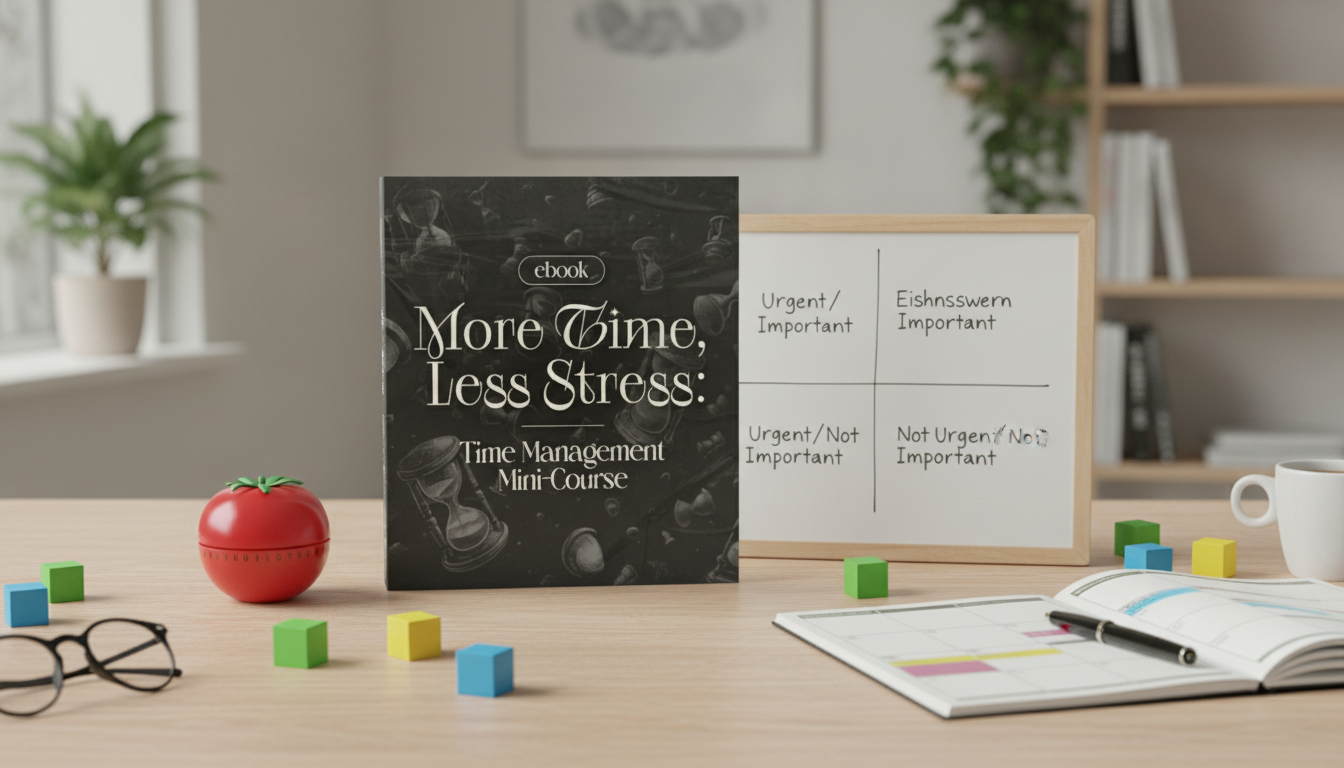
Busy schedules rarely fall apart because motivation is missing. They fall apart because priorities compete, tasks expand to fill the space you give them, and interruptions quietly “decide” the day. The More Time, Less Stress: Time Management Mini-Course – Productivity Ebook with Pomodoro, Eisenhower Matrix & Time Blocking Strategies is built around three simple systems that reduce decision fatigue and protect focus: Pomodoro sprints for momentum, the Eisenhower Matrix for clearer priorities, and time blocking for realistic daily plans.
Who this mini-course fits (and who it doesn’t)
This mini-course works especially well for overloaded professionals, students, caregivers, and anyone juggling many small tasks alongside a few big projects. It’s also a strong match when procrastination shows up as “planning more,” constant tab-switching, or starting the day reactive to messages.
It’s less ideal if your schedule is highly unpredictable hour-to-hour—though it’s still usable with smaller blocks and stronger buffers. The most helpful mindset is consistency and recovery from off-days, not building a “perfect” schedule that collapses the first time life gets messy.
The core problem: time leaks and stress loops
Most overwhelm comes from two patterns:
- Time leaks: low-value tasks, over-scrolling, unplanned “quick replies,” and meetings without clear outcomes.
- Stress loops: unclear priorities → constant switching → slower progress → longer hours → less rest → lower focus the next day.
The fix isn’t more willpower; it’s clearer rules for what gets done, when it gets done, and what gets deferred. A good system creates fewer daily decisions, visible progress, and reliable stopping points. Stress is also not “just mental”—it can affect the body and recovery, which is why realistic plans beat heroic overwork (see the American Psychological Association’s overview of how stress affects the body).
Pomodoro: build momentum in focused sprints
Pomodoro sprints use timed intervals to lower starting friction and make progress measurable. The standard rhythm is 25 minutes of focus and 5 minutes of break; after 4 cycles, take a longer break.
- During a sprint: do one task only. Capture interruptions on a note list instead of switching.
- After a sprint: choose the next smallest action (not the next big goal) to keep momentum.
- Useful adjustments: 40/10 for deep work, 15/5 for admin, and a “two-Pomodoro rule” to start intimidating tasks (commit to just two sprints, then reassess).
For a deeper origin story and the core method, see Francesco Cirillo’s Pomodoro Technique.
Pomodoro setup by task type
| Task type | Suggested sprint | Goal of the sprint | Example |
|---|---|---|---|
| Deep work (writing, analysis) | 40/10 | Sustained concentration | Draft 2 sections without checking messages |
| Admin (email, scheduling) | 15/5 | Fast processing | Triaging inbox to zero new decisions |
| Household/errands planning | 25/5 | Batch decisions | Create a grocery list and place one order |
| Study/practice | 25/5 | Repetition and recall | Flashcards + 10 practice problems |
Eisenhower Matrix: decide what deserves attention
The Eisenhower Matrix sorts tasks by urgency and importance so you don’t spend your best hours on the loudest requests.
- Important + urgent: handle first with full focus, then reduce repeats by adding a process (template, checklist, automation, clearer brief).
- Important + not urgent: schedule into time blocks—this is where long-term goals actually happen.
- Not important + urgent: delegate, template, or limit. These “must respond” items are often the main source of reactive stress.
- Not important + not urgent: remove, restrict, or replace with restorative breaks.
When everything feels urgent, the matrix becomes a pressure-release valve: it forces a decision before the day forces one for you.
Time blocking: turn priorities into a realistic day plan
Time blocking assigns tasks to specific windows so the day isn’t run by a never-ending list. Start with fixed commitments (classes, meetings), then add 2–3 priority blocks, then admin blocks, then buffers.
Time blocking is widely associated with deep work practices; Cal Newport’s essays and resources are a helpful companion for sharpening this habit (see Cal Newport’s time blocking and deep work writing).
A simple weekly workflow that combines all three methods
Common obstacles and quick fixes
Mini-course overview: what’s included and how to use it
Helpful add-ons for a calmer, more focused workspace
- More Time, Less Stress: Time Management Mini-Course – Productivity Ebook with Pomodoro, Eisenhower Matrix & Time Blocking Strategies (digital mini-course)
- Nordic Rattan Leisure Single Sofa Chair – Solid Wood, Modern Fabric Design (a dedicated reading/review chair for shutdown routines)
- Elegant Art Deco-Inspired Crystal Branch Chandelier for Dining Room (clear lighting for planning sessions and low-distraction evenings)
FAQ
How fast can results show up with Pomodoro, the Eisenhower Matrix, and time blocking?
Many people notice immediate clarity on day one because priorities and work windows become visible. Consistency typically strengthens in 1–2 weeks as sprints and blocks become routine, and better workload balance often shows up in 3–4 weeks once you’ve tracked what tasks truly take and adjusted buffers.
What if the schedule is unpredictable and time blocks keep getting interrupted?
Use smaller blocks (15–30 minutes), add buffer blocks, and define a “minimum viable day” with one protected focus window plus flexible admin time. Keep a capture list for interruptions so you can return to the block without mentally restarting from zero.
Is this better for students, remote work, or managing a household?
It’s adaptable to all three: students can block study sessions and run Pomodoro practice sets, remote workers can protect deep-work blocks before meetings, and households can batch errands and planning into short sprints. A practical approach is one primary outcome per day plus one maintenance block to keep life moving without overload.















Leave a comment